Senior Product Designer · Bengaluru, India
Hello, I’m
B2B SaaS · AI Products · Enterprise Platforms · 4+ years
Complexity is inevitable in enterprise. Confusion isn’t.
I design AI-powered B2B platforms that turn overwhelming, data-heavy systems into intuitive, decision-ready experiences — owning every product from blank canvas to measurable revenue impact.
Owned end-to-end — discovery, IA, design execution, handoff, and measured results. Click any card to read the full case study.
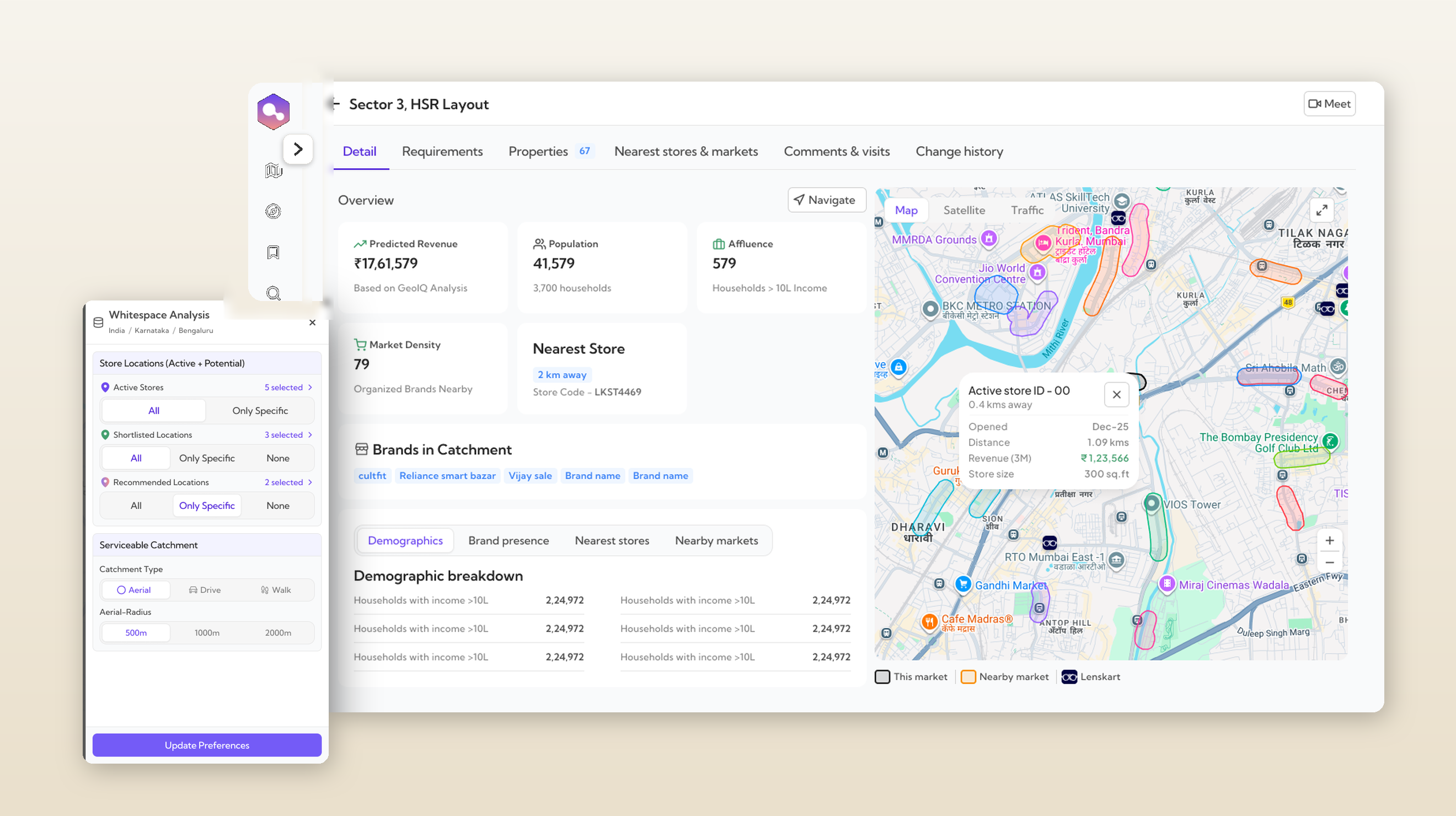
Turned 25,000+ location data signals into a boardroom-ready expansion tool for India’s largest retail chains — replacing ₹100Cr+ gut-feel decisions.
Unified 3 roles — brand managers, BD teams, 700+ brokers — into one multi-sided workflow platform, replacing a chaos of WhatsApp and spreadsheets.
Eliminated 3–4 hrs of weekly manual reporting for area managers with an anomaly-first dashboard that auto-generates AI action briefs.
Led UX for Lenskart's conversational AI across web and 2,000+ stores — trust model, voice flows, precision sizing, AI checkout. 8 languages. +17% conversion via A/B.
Four domains with repeated, shipped experience — not just familiarity.
Data layering, information density management, real-time signal rendering at Google Maps or Uber-scale complexity. Built RetailIQ 0→1 for India’s largest retail expansion teams.
High-density platforms where expert and first-time users coexist. PropIQ onboarded 700+ brokers with zero training material. I design for adoption, not just task completion.
B.ai end-to-end: voice interaction model, trust signals, precision recommendation flows, AI-guided checkout. +17% conversion lift via A/B on Lenskart’s platform serving 2.5M monthly active users. AI for trust, not novelty.
Anomaly-first layouts, drill-down hierarchies, AI-generated summaries replacing manual reporting. Shipped for enterprise retail, fintech analytics, and B2B SaaS ops teams.
Senior Product Designer
GeoIQ · Acquired by Lenskart
Bengaluru, India
I’m the designer who owns the whole problem — not just the screens.
At GeoIQ (acquired by Lenskart), I joined as founding designer and built the entire UX practice from zero — research processes, design system, critique cadences, and all four products — while the company pivoted from services to product-led SaaS. Promoted to Senior Product Designer in May 2025.
My edge is breadth without shallowness. I’ve shipped map-based data platforms handling 25,000+ signals, AI conversational flows for millions of users, enterprise workflow systems with zero training adoption, and analytics dashboards that eliminated manual reporting. Each owned end-to-end.
My full-stack dev background (HTML, CSS, JS) means specs engineers trust, high-fidelity prototypes, and build-vs-design trade-off calls before they stall the backlog.
Open to Senior PD and PD2 roles in B2B SaaS, AI, or enterprise. I respond within 24 hours.
City Maps workspace — layer-toggles for income bands, footfall, competitor density, and custom location sets. Designed for brand analysts without GIS expertise.
India’s fastest-growing retail chains — QSR, fashion, pharmacy — were making ₹100Cr+ site decisions using broker relationships, gut feel, and spreadsheets. The data existed but lived in silos: footfall APIs, census datasets, competitor scrapers. No one had stitched it into a usable decision tool for non-GIS users.
Sole product designer at GeoIQ. I owned everything from initial discovery through production handoff — user research with retail expansion teams, information architecture, the map interaction model, progressive disclosure system, component library, and all high-fidelity screens.
Comprehensive site report — catchment potential tab showing total households (4,50,880), affluence indicators, income bands, and competitor/complimentary brand overlays. Every data point surfaced from a single pin on the map.
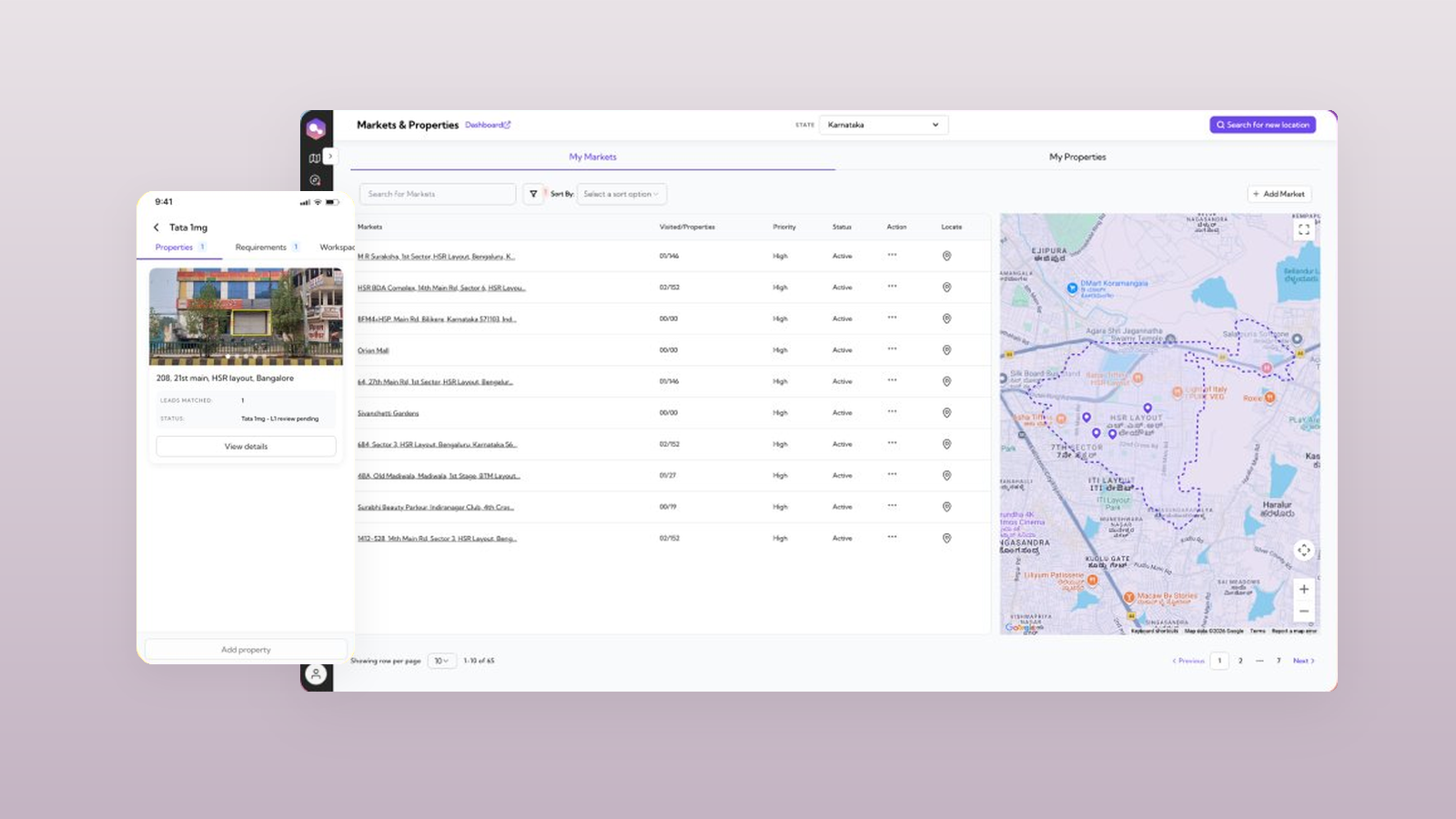
Expansion Decision Dashboard — list-map split view showing markets under evaluation across Karnataka, with priority status, visited/total properties ratio, and direct map navigation.
PropIQ overview — broker-facing lead management, property detail with brand-matching status, requirement specs, and an AI-assisted improvement panel nudging brokers to fix submission gaps before review.
Retail brands expanding across India needed a reliable pipeline of qualified properties. But the broker network — hundreds of independent agents — was submitting via WhatsApp, email, and phone calls. Properties were duplicated, incomplete, or simply lost. Brand expansion teams had no visibility into the pipeline at all.
The challenge: three distinct user types (brand expansion managers, business development teams, and brokers) with completely different contexts, digital comfort levels, and definitions of progress. Building a single system that served all three was harder than building three separate tools.
Lead designer. I ran discovery research with all three user types, mapped journey conflicts across roles, designed the information architecture for the multi-role system, and owned all screens through to engineering handoff.
Market-level workflow — brand managers define catchments per locality, standardize property requirements, and directly activate brokers with a structured brief. Cuts time from planning to broker pipeline.
Property submission flow — brokers can add properties in two steps from mobile, with the catchment context always visible. Standardised briefs mean every submission is pre-aligned with brand requirements.
Quality gate flow — every broker-submitted property undergoes structured validation across 11 steps (site info, competitor analysis, market overview) before an approval deck is auto-generated for the brand.
MarketConnect — the brand-side counterpart to PropIQ, enabling expansion teams to evaluate, prioritise, and approve high-potential markets before sourcing begins.
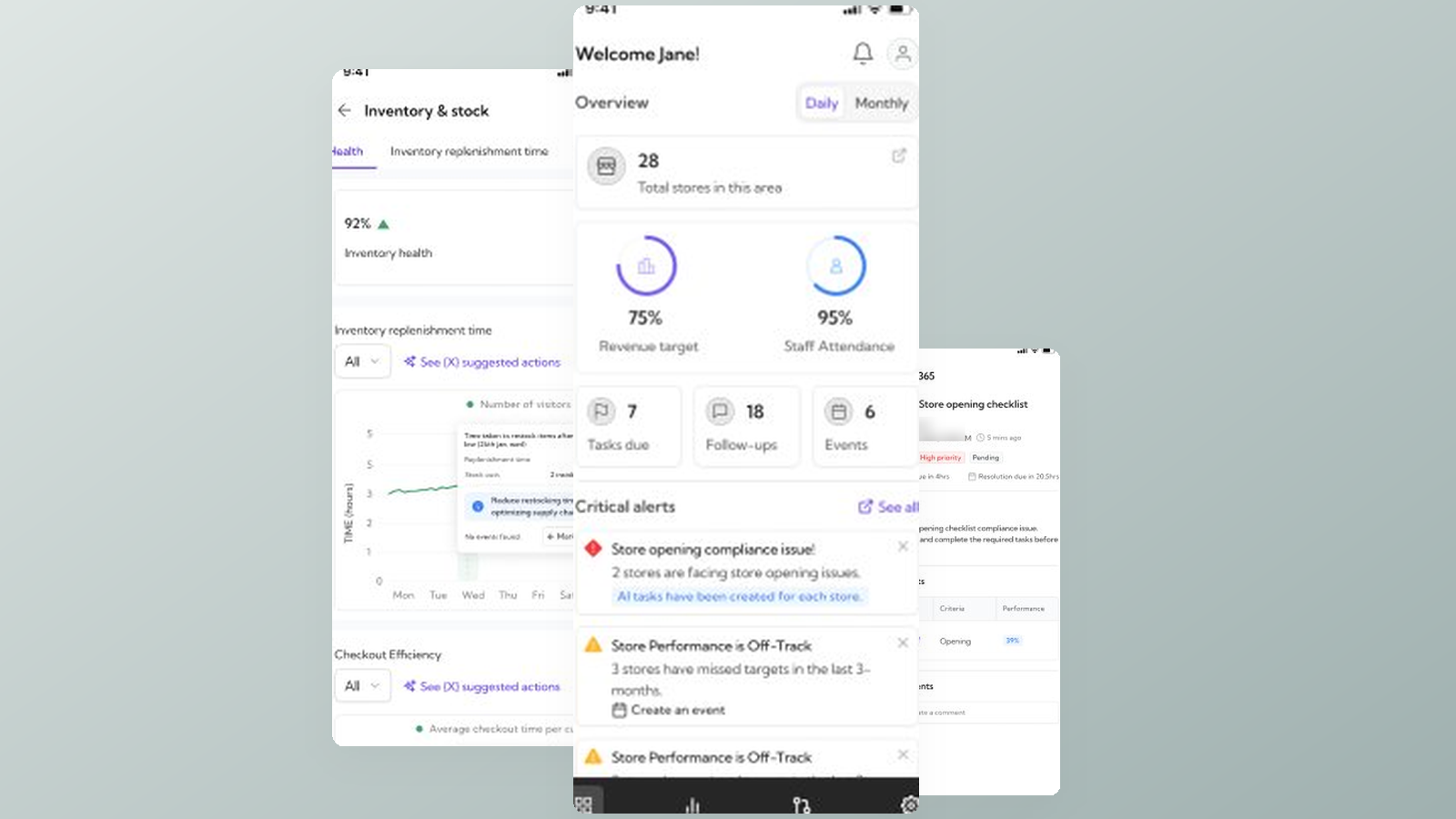
PerformanceIQ hero — a centralised dashboard enabling area managers to monitor revenue targets, flag operational risks, and trigger corrective workflows across hundreds of active stores.
Area managers overseeing 28–50+ live stores had no single view of what was underperforming and why. Existing reporting required manually pulling data from separate systems, pasting into Excel, and spending 3–4 hours every Monday morning just to get the picture. By the time they had it, half the week’s intervention window was gone.
Worse: because the process was so painful, many managers had quietly stopped doing it consistently. Compliance issues, revenue misses, and staff attendance problems were going undetected for weeks.
Lead designer. I conducted contextual research with area managers across store networks, designed the full dashboard system, and worked directly with engineering on the anomaly detection and alert trigger logic.
Alert-first layout — the overview surfaces critical issues immediately (store opening compliance, performance off-track, NPS failures) with auto-created tasks for each store. Managers see the most urgent problem before anything else.
Operational health module — forecasted revenue vs. target with AI-suggested actions, staff attendance anomalies by store, inventory health + replenishment time, and reputation score. Each section surfaces “See (X) suggested actions” so managers always have a clear next step.
B.ai entry points — “Talk to B in 8 languages” banner on the Lenskart homepage, Meet B.AI onboarding sheet, microphone permission request, and the live conversational stylist interface: “Hi! I’m B, Lenskart’s eyewear expert.”
Lenskart serves 300M+ users across 2,000+ stores and a massive online catalogue. But frame selection was broken: customers had no reliable way to know which frames would fit their face, match their style, or suit their occasion. Browse-to-abandon rates were high. Returns were expensive. Customer service was overwhelmed with pre-purchase questions.
Post-acquisition of GeoIQ, I was tasked with designing B.ai — a conversational AI stylist that would be embedded directly into the Lenskart shopping experience and available in 8 languages.
Lead designer for the B.ai product. I defined the conversational interaction model, designed the voice permission and onboarding flow, built the trust and explainability patterns, and designed the frame recommendation and checkout assistance experiences.
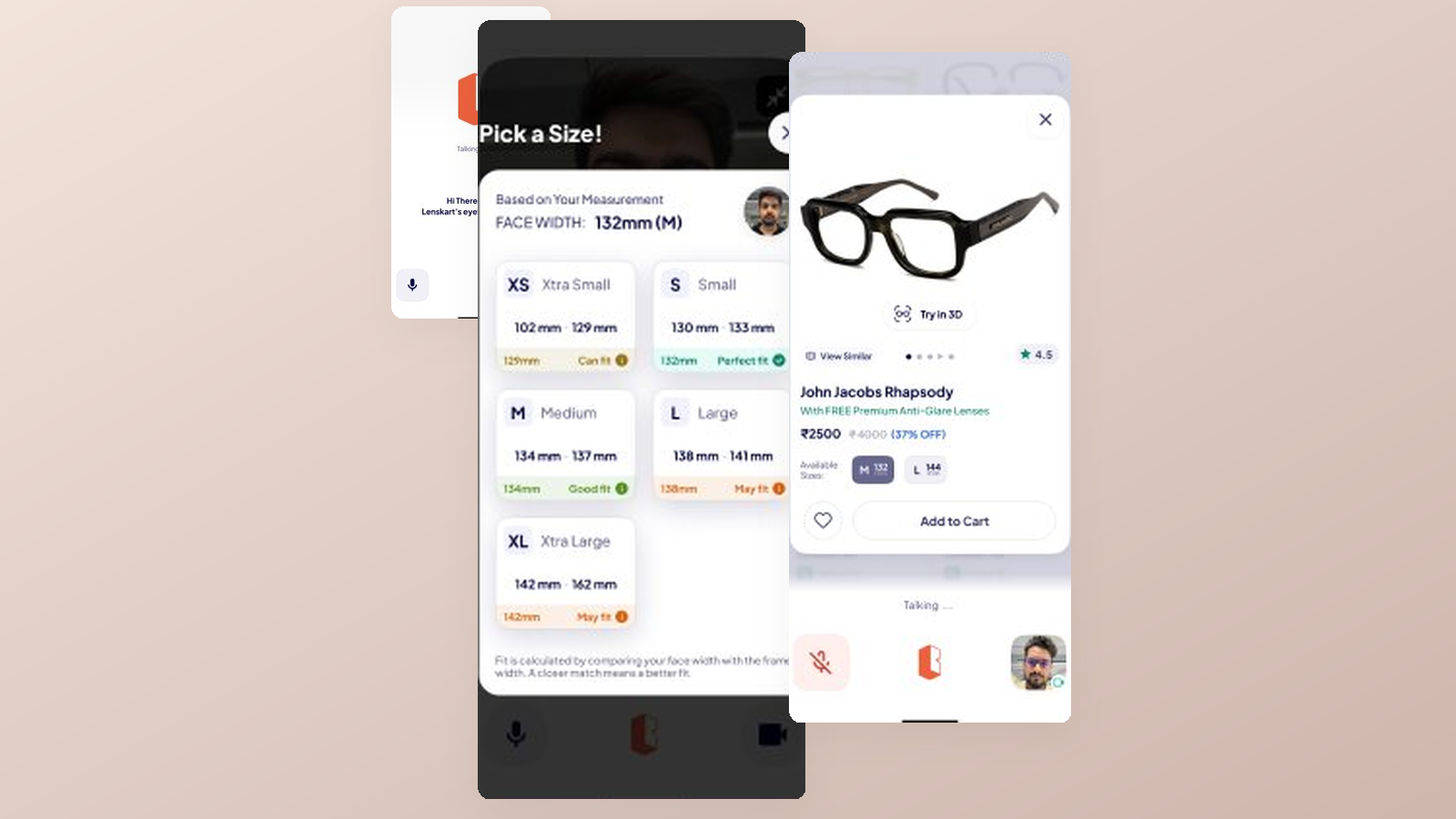
Smarter frame selection — voice-enabled AI recommendations, precision sizing grid (face width 132mm M = Perfect Fit highlighted), and 3D try-on. Users go from browsing to confident selection in a single AI conversation.
AI-guided checkout — B.ai reads out saved addresses, confirms the payment amount (₹45,200), and takes the user to the payment page via voice. Designed for users who browse with one hand and find form-heavy checkout exhausting.