Choosing eyewear is not just about finding a frame in a catalogue. Fit, size and how a frame looks on someone all affect the decision, and those questions are difficult to answer from a product grid alone. B.ai was designed to bring more guidance into that online journey — closer to the kind of help someone would normally look for while deciding between frames.
B.ai had to help people move from browsing to deciding
B.ai wasn't built as a separate app or novelty chat window. It lived inside the existing shopping journey. Its job was to narrow the distance between browsing a large catalogue and feeling confident enough to choose a specific frame.
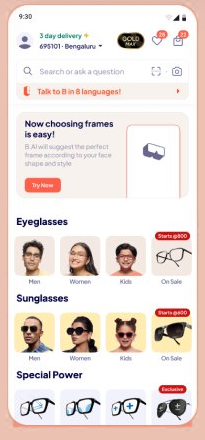
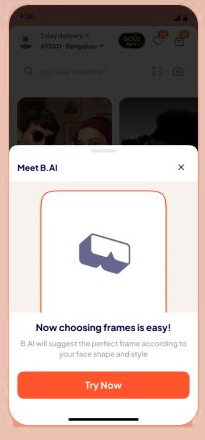
Explain the value before asking for the microphone
The user sees what B.ai is for before the operating-system permission dialog interrupts the journey. The flow is sequenced in this order — value and language context first, the permission ask second, not on page load.


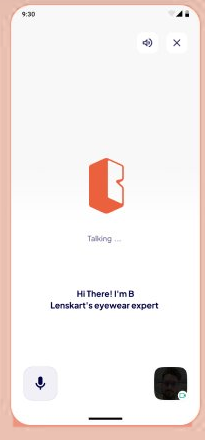
Voice alone wasn't enough
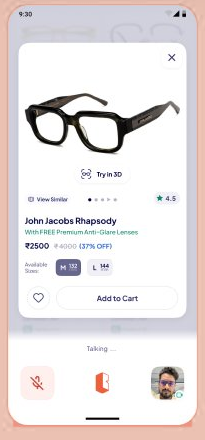
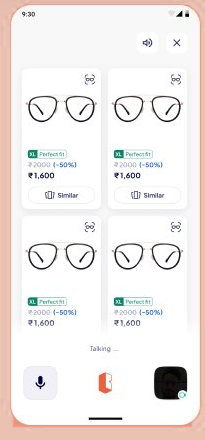
Once the conversation starts, B.ai doesn't just talk — it renders. While B is speaking, the relevant product information appears on screen at the same time, so a shopper never has to hold an entire recommendation in their head from audio alone. Voice carries the guidance; the screen carries the specifics. Neither one is doing the whole job.
A recommendation is easier to trust when you can check it
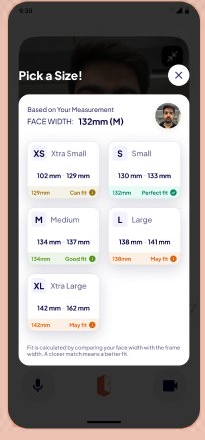
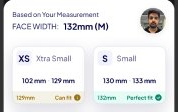
Instead of asking someone to pick S/M/L and hope, B.ai surfaces the actual number — a 132mm face-width measurement — and shows exactly how it maps to each size, labeled by fit quality rather than a generic size name.
From recommendation to purchase
The product card also exposes a ‘Try in 3D’ entry point before checkout.
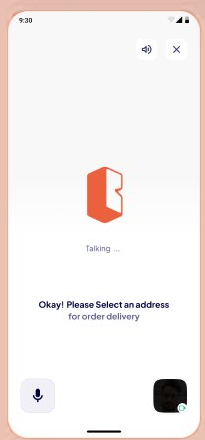
A recommendation only matters if the journey can continue without losing clarity along the way. B.ai stays conversational through checkout — guiding the user through address selection, confirming the payment amount, and narrating the handoff to the payment page. At each consequential step, the interface makes the next action explicit rather than silently moving the user forward.



The useful question wasn't how conversational the AI could feel. It was how much of its reasoning and action the user needed to see before letting it move the purchase forward.